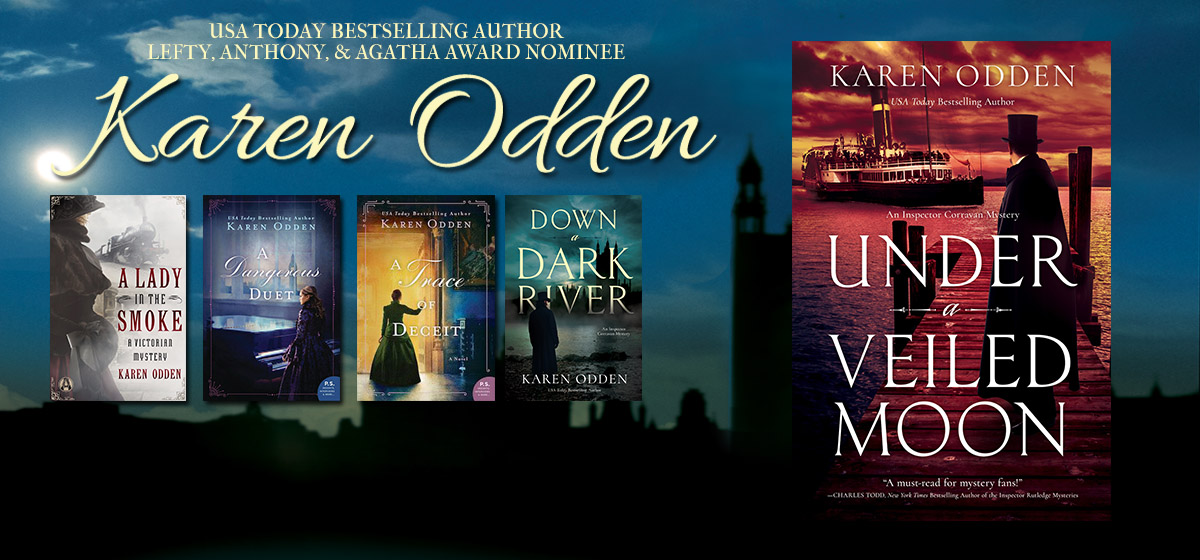
At Malice Domestic last month, I was on a panel called “What do you wear to a murder? How fashion enhances a novel.”
I must admit, when I received the panel assignment, my first thought was, “I’m on a panel about fashion?” Aside from the fact that my personal closet has nothing worthy of comment, my Victorian protagonist, Inspector Michael Corravan, has all the fashion sense of a contemporary teenager who picks a t-shirt up off his floor and sniffs it to make sure it’s clean enough to wear.
But once I began paging through my book DOWN A DARK RIVER and the previous one, A TRACE OF DECEIT (2019), I realized … Hm! I do talk about clothes! Descriptions of overcoats, hats, dresses, shoes, canes, collars, hats, gloves, and so on feather into my character descriptions and scenes because my characters are sharply etched in my mind, and their clothing naturally reflects aspects of their identity—their age, race, gender, occupation, class, and so on.
However, clothing doesn’t only reflect aspects of a person’s identity; clothing can also either thwart people’s expectations or fulfill them. People (and book characters) can manipulate conventions of apparel (a.k.a. “sartorial codes”) to their advantage. As a simple example, in my second novel, A DANGEROUS DUET (2018), my heroine Nell dresses as a man to play piano in a music hall because male performers were paid 20 shillings a week, and women were paid 10.
One thing to recognize about the Victorian era is that there was no single “Victorian style.” Fashions for women and men changed drastically over the course of Queen Victoria’s reign, 1837-1901, influenced by dozens of factors including trends in architecture, such as the Gothic Revival whose narrow arches and angles lent shapes to women’s dresses, and the rise of leisure time, which necessitated clothes for boating, archery, and lawn tennis. New fashions depended upon what fabrics and dyes were available and upon evolving techniques such as gauging (a new way to form pleats at the waist) and the steam-molding of stays. In 1857 the development of the lightweight metal frame replaced the petticoats made of crinoline—a word derived from the French crin (horsehair) which was added to lin (linen) to make it bulkier. Until then, some fashions, with hems up to 5 or 6 yards in circumference, required the wearing of 6 petticoats! Can you imagine how hot that must have been?

Dresses physically reinforced the social, economic, and psychological constraints upon women during this period. Not for nothing do the metal hoops resemble a birdcage.
Victorian clothing was often used very intentionally to convey a message to the broader public. One real-world example of this occurred in 1829, when Home Secretary Robert Peel created the Metropolitan Police. Although Peel’s intent was to create an organization that would deter crime and protect the public, many Londoners were deeply distrustful that the creation of a unified police force would turn the city into a police state; their personal liberties would be trampled; and the police would be no better than French spies, peering about and condemning their every move, looking for a reason to throw them into prison or to collect a bribe for letting them go free.

The style of uniform was chosen to reassure the public. Rather than dressing the new police in red military coats with brass buttons and epaulettes and helmets, with the men carrying firearms, the new police uniform was a gentlemanly blue swallowtail coat and trousers, overcoat, ordinary boots, and a leather top hat, and the police carried a truncheon rather than firearms. That said, their top hat was reinforced with cane so it could serve as a step-stool when peering over walls in London. The brim was also reinforced, to be used as a weapon that could break someone’s nose. But the chief concern with regards to the uniform was reassuring the public.
Divisions of plainclothes detectives came into being in August 1842, after an attempt on Queen’s life and several other notoriously brutal crimes. So in 1878, Inspector Corravan, who came up through the Lambeth uniformed division, wears an overcoat that conceals the truncheon he tucks into a special pocket down the side of his trousers. There is no obvious sign of him being a policeman.
However, in DOWN A DARK RIVER I use clothes not only to indicate aspects of identity such as class, profession, and gender but also to suggest themes and character traits. For example, Tom Flynn, the newspaperman, is one of the moral compasses of the novel. He wears an overcoat that hangs a bit too long on him, which emphasizes that he is shorter than average; this provides a contrast to, and perhaps suggests a source of, his oversized determination when pursuing a story. His bowler hat is misshapen because of the long nights spent in the rain; this suggests his work ethic, an important value in Victorian culture.

I also show how clothing can be used as a form of communication, a way of signaling rebellion, admiration, or even affection between characters. For example, Mr. C. E. Howard Vincent (an historical figure) becomes the Director of the Yard — the new broom that sweeps the Yard clean after the 1877 “Trial of the Detectives,” when senior inspectors were convicted of taking bribes from a gang of con men. Mr. Vincent is the second son of a baronet and has never spent a day in police uniform or solved a case. Rather, he’s a former newspaperman for the Daily Mail, and he earns his new position at the Yard because he went to France to interview the police about their methods and presented his findings to the Parliamentary Commission that was deciding the fate of the Yard. (Yes, they were nearly shut down.) Vincent is tall and slender, and in this illustration from Vanity Fair, it is evident that the Victorian long coats and tailored trousers suit him. By contrast, Irish Inspector Corravan from Whitechapel wears a large dark overcoat and pays little attention to his dress. It is one of the subtle ways Corravan rebels against Mr. Vincent’s tidiness, his rigidness when it comes to the rules, and his adherence to upper-class Victorian codes of dress and behavior.
Like Mr. Vincent, Belinda Gale, Corravan’s love interest, attends to matters of dress. She is an independently wealthy lady novelist based in part on some real women authors of the time, including George Eliot, Mrs. Henry Wood, and Mary Elizabeth Braddon. Belinda dresses as befits her station, with gowns in the latest fashion, for the soirees she holds. Dressing beautifully for Michael Corravan is also one way she shows her affection for him. (My paper doll Marie models a style of hair and dress from 1878, the year the book is set.)

Paradoxically, the stricter the sartorial codes within a given world (fictional or real), the more powerfully they can be wielded and subverted. Considered broadly, clothing is at the nexus of cultural aspects including politics, economics, manufacturing, art, gender, class, race, profession, and social mores. Because clothing can be donned and doffed, the line dividing character from costume is murky, and it is in that murk, thick as the London fog, where the novelist can find rich opportunities for exploring identity, motives, and behavior.
With special thanks to my sister panelists, authors L.A. Chandlar, Andrea Penrose, Karen Neale Smithson, and Ellen Byerrum; and to Robin Agnew for suggesting the panel topic.


