
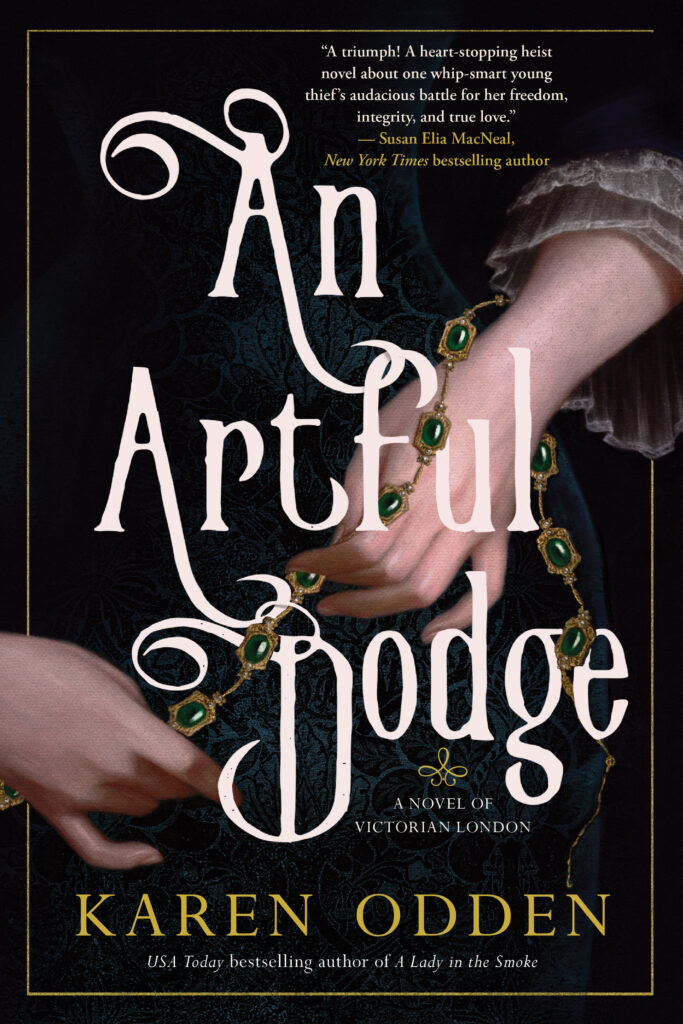
An Artful Dodge by Karen Odden, available June 02, 2026 from your favorite bookseller!
CHAPTER ONE
The Society for the Suppression of Vice would have you believe crime doesn’t pay. Certainly not thieving.
It does, of course.
One glance around the spacious dormered practice room—
with countertops heaped with stolen finery, from jeweled pins to pocket watches, and fourteen women practicing their dodges upon each other—would tell you so.
“I felt that, Kit,” Mary said, and my fingers stilled on the necklace I was trying to lift.
“You didn’t,” I said, pulling back.
“I did,” she insisted, touching her nape below the chignon of fair hair. “Your fingers, here.”
“Try again,” Amelia said, looking over from instructing Bea on nicking a pocket watch one-handed. “Use the side of your thumb.”
Her tone was sharpish, without its usual good humor.
“What’s wrong with Amelia?” Mary kept her face toward the window and her voice low. “You don’t think it’s because I’m going back out today, do you?”
I felt her anxiousness, pin-sharp inside my own ribs.
“I doubt it,” I replied. “She’s riled over something. But likely it’s Harriet and Elsie.”
They’d both nearly been caught by constables the previous week, which is why the air in the room was subdued, and our practice more intent than usual. While we thieves shoved our fears down far enough to step over them, we also took a warning from anyone else’s narrow escape. This was earlier in autumn than we usually changed over to doving, but we always shifted to the theaters and music halls during election season, when city officials needed the support of the West End shopkeepers and pushed the police to reallocate uniformed constables to Mayfair and Marylebone. After the votes were tallied and the officials safely in their seats, the coppers would slink back to their usual boroughs, and we’d return to the shops.
“Why don’t you have a go,” I said to Mary, over her shoulder. “Nicking a necklace is harder than pockets.”
“It’s because your hands are cold,” Mary said. Because this whole room is cold, I thought. The bustling taproom on the ground floor of the Elephant and Castle Inn was warm, but the practice room was two full stories up, and the heat didn’t rise through the thick old plank floors. A coal fire burned in the potbellied black corner stove, and the room held the heat of us thieves, but the unseasonable chill this August afternoon shoved in around the leaded windowpanes.
I rubbed my palms together and blew on my fingertips.
From behind one of the reproductions of wood-and-glass store cabinets, Josie called out, a sly laugh edging her voice. “Robbie downstairs’ll warm ’em up for you, Kit!”
“Robbie downstairs is an eejit,” I replied in the same sing-song, curling and straightening my fingers. “It’s not fair,” I said to Mary, as I jostled her elbow lightly and undid the clasp, taking care to drop the loose end on top of her collar instead of on bare skin. “You know I’m coming.”
“I’m playing fair, I promise,” she protested. “See? I’m looking out the window, letting myself be distracted like a lady watching a show. There’s Sophie, going into the bakery, . . . and Mr. Ardle heading toward his shop.”
I showed her the necklace. “There.”
Her blue eyes widened in approval. “Oh, that was bloody good.”
I grinned. “Your turn now.” I clasped the necklace around my own neck and turned to face the room.
Spread across the mock shop counters were four lacquered trays of necklaces, watches, handkerchiefs, earrings, reticules, brooches, and pins—all objects easily nicked from the theater crowd and passed to the fences of Vine Street. We were in pairs, each working with our usual jenny, taking turns at playing the mark, as Amelia walked among us, showing us new ways to distract, directing our hands, reshaping the positions of our fingers. Fanny was showing her new jenny how to tuck a bracelet inside her hat brim. Another new girl watched carefully as Charlotte demonstrated how to palm an earring and slip it into her hairnet. They say there’s no honor among our sort, but there’s a certain thickness to us thieves.
On the other side of the room, in front of a large printed wall map of London with Amelia’s pins in it, Josie swung a silver-headed walking stick she’d nicked the day before. “Look at me, like one of the music hall toffs, singing about how the ladies love my big stick.” She swung her hips back and forth, drawing the words long, and her jenny, Bea, burst out laughing.
The necklace slid along my neck. “Felt that,” I said.
“Argh,” Mary said. “Are my fingers cold?”
“No. The chain moved.” I tapped my collarbone. “Here.”
“Ah, right.”
Here we are again, I thought, recalling the first week we practiced our tooling in this room, slipping our hands into each other’s pockets, when I was fresh to all of it and Mary only a few months along. The difference now was we knew each other, down to a darted side-eye toward a plainclothesman, a long breath to sketch a warning, a shilling-thin shoulder lift when the dodge was done. It takes time to earn that sort of knowledge. We’d been each other’s regular jennies for almost four years, and I counted myself lucky Amelia had paired us early on. I wouldn’t have done so well with any of the others. Not that they weren’t good thieves, just not the sort I’d ever truly trust, the sort who’d play every card she had to be sure I got away.
“There,” Mary said, dangling the necklace between her thumb and forefinger. “Did you truly not feel it?”
“Not a thing,” I said honestly. “You’re better at touch work.”
At the center of the room, Amelia clapped her hands crisply. “That’s enough for today, yeah?” We all broke off, and amid the chatter that burst out after several hours of intense concentration, we emptied our pockets, reticules, and hairnets of practice objects. Amelia laid the four trays on her desk, filling them with goods. We all started toward the stairs that led down to the first story, which was divided between the goods room, where we unloaded our poke each day, and the costumes room, where we stored our thieving clothes. Josie gave one last twirl of the walking stick before she vanished through the door.
“Kit,” Amelia said as I reached the threshold.
I stepped back. Mary shot me a meaningful look that I returned—Don’t worry—and Mary departed with the rest, shutting the heavy door behind her.
The afternoon sun coming through the window caught the silver threads in Amelia’s dark hair, the fine lines around her mouth. She laid the last of the bracelets on the third tray and tucked it into the hidden wall safe before she met my gaze. Her blue-gray eyes were steady. “Well? Is Mary ready?”
“Aye,” I said. “It’s been four months, and she says she’ll go stark raving if she’s kept out much longer. She’s used to working.”
“I know.” Amelia transferred the fourth tray, handkerchiefs and reticules, into the safe, spun the lock, and shut the wooden panel. “But it won’t do her or you any good, if her nerves aren’t steady.”
The thought of Mary’s mother knifed twice under the ribs and left to die in an alley still unsteadied my nerves, if I let myself think on it.
“You can skip today, if you want,” Amelia said. “Given the constables.”
“We’re fine,” I said. Even if Mary wasn’t quite ready, she was a skilled thief, and I wanted to let her return in the shops, where we’d succeeded a hundred times. Besides, I’d be the lead today; Mary was the decoy. Even if she was caught, they’d find nothing on her.
“I don’t want you covering for her, Kit,” Amelia added. “And they’ve just stationed a plainclothes at Bradley’s, so take Pickford’s instead, yeah?”
Amelia had a source at the Yard.
“When will we begin doving?” I asked.
“Soon,” she said. “After tomorrow, I’m pulling you all out of the West End.”
Recalling her sharp tone during our practice, I asked, “Is something the matter? Besides the extra constables?”
A flicker in her eyes came and went. “No.” She tucked a dark lock of hair back into her hairnet. “Just being cautious. Elsie had to run for it, and Harriet would’ve been caught if not for Gus.”
That hair tuck was Amelia’s tell. But the set of her jaw told me I’d get nothing more, so I said only, “That’s what I heard. Gus set his dog on the constable.” Harriet had told the story for a laugh in the pub room, but her voice had held a shrill note.
“Aye.” Amelia glanced up at the clock, and I followed her gaze. Half past one. Three hours before people headed home for tea, the crowds thinned, and thieving was harder. “All right, then,” she said.
I took it as a dismissal and started for the door.
“Wait, Kit. How’s Sarah? Is she doing better?”
I turned back, feeling a warm glow of gratitude at her concern. Amelia knew my younger sister had just taken a position as a scullery maid, where the work was hard. “I think so, but—well, she hasn’t sent her usual letter, though she’s home tomorrow.”
Amelia saw my worry. “No doubt she’s busy working,” she said reassuringly. “And knowing her, she’s likely making friends with any time left over.”
I smiled. “Thanks, Amelia.”
“Ádh mór ort,” she replied with a wave of her fingers.
The ring’s founder, Patty Wirth, had been Irish, and though she’d been dead these fourteen years, this phrase was still how we wished each other luck.
Downstairs in the taproom, I found Mary sitting at a corner table with Josie and Bea, who were drinking pots of golden ale with a thin layer of froth, drawn fresh from the taps. Mary was not; we never drank before a dodge, not even ale. As I approached, Mary rose and stepped away from the table.
“She asked about me?” Mary murmured.
“She did, but there’s something else troubling her,” I replied, my voice low. “She wouldn’t say.”
“Hm. Well.” Mary turned to beckon to her nephew Sid, her palm up, her quick fingers folding in twice. He slouched away from the table where he sat with other boys.
“What?” he asked.
She ruffled his hair, and he ducked away.
“Pickford’s at half past three,” I said. “Don’t be late.”
“Yah.” He sniffed and turned away and went back to his friends.
Mary turned to me, rolling her eyes, half annoyed, half amused. “Let’s get ready.” We went upstairs to the costume room, where racks held dresses with thieving pockets that reached to the bottom of the crinolines, coats lined with fisherman’s netting that easily caught jewelry, trousers with adjustable turnups, two-sided cloaks, paste jewelry good enough to pass for genuine, hats, spectacles, paste-on moles, and such. Mary carefully braided my brown hair tight to my scalp to fit under the wheat-colored wig. We each chose a cloak, a reticule, gloves, and a hat, then set out for the West End.
Ready for more? Order An Artful Dodge by Karen Odden from your favorite bookseller!