The Real Women behind Kit Jimeson
Originally published on SUBSTACK/Murder is Everywhere (April 2026)
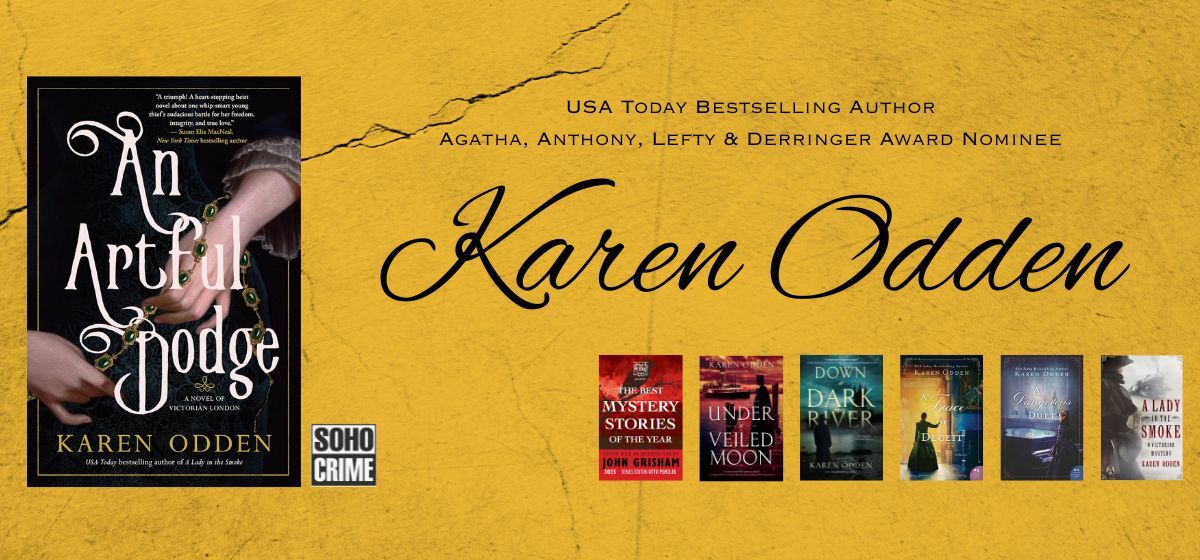
Kit Jimeson is the heroine of my new book, An Artful Dodge (coming June 2). She did not spring sui generis from my crafty brain. History was my accomplice, helping me create Kit and the gang of thieves she works alongside.
Thanks for reading Murder Is Everywhere! Subscribe for free to receive new posts and support my work.

I first discovered the (real) women thieves who were operating in the 1870s in London a few years ago. One rainy, windy night in 2021, my daughter Julia and I were in London. Our umbrellas misshapen and in a woeful state, we popped into the Victorian-themed Great Scotland Yard Hotel, within the shadow of Big Ben, for a drink. The bar there was called The Forty Elephants (above), and there was a picture of a beautiful woman above the fireplace.
Naturally, I was curious about the name and about her, and fortunately, there was a sticker with a QR code on the table with “For more information about the 40 Elephants” above it. I imagined the bartenders and waitresses demanding them after being asked for the thousandth time by tourists such as myself, “Why is this called the Forty Elephants?” I found, much to my surprise, the eponymous elephants had nothing to do with the British Imperial projects in India or Africa (homes of real, floppy-eared gray elephants). The Forty Elephants were a gang of women thieves, named for the neighborhood whence they hailed.
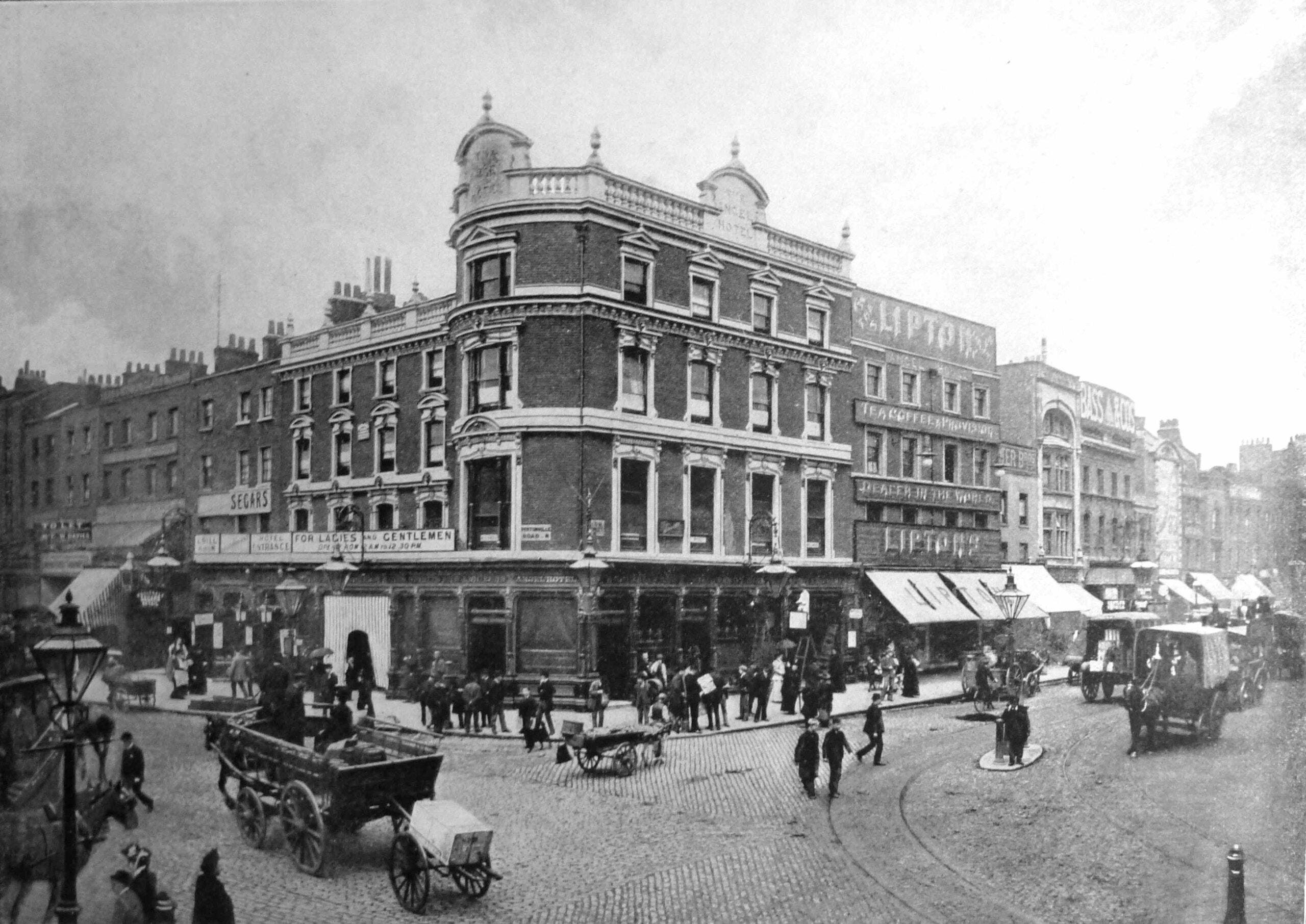
Dating from 1765 (although some claim it existed as early as 1754), the old coaching inn Elephant & Castle (above) was situated at the nexus of six or seven — depending on how you count — major roads, some of which had been there since the Roman times. By the early 1800s, the roads brought in travelers from Dover, Canterbury, and various parts of London. If legend is true, wealthy stagecoach travelers were sometimes put in a comfortable chair by the fire, dosed to sleep with wine (and perhaps a tipple of laudanum), and robbed of everything down to their shoes overnight. If they had anything left, muscular Castle men known as “draggers” might leap on the back of the stagecoach the next morning and pull luggage off the roof once it was rolling.
The gang that eventually became known as the Forty Elephants came into being in the 1870s with the rise of department stores. The heyday of the Forty Elephants was between the two world wars, and they were still active through the 1940s, although Scotland Yard made many attempts to shut them down.
The earliest leader of the gang was probably Mary Carr, born in 1862. She became loosely involved with the male thieving gang from Elephant and Castle in the 1870s, eventually working her way into the leadership position, with the nickname “Queen of the Forty Thieves,” until she was tried, convicted, and imprisoned in 1905. From 1915, the gang was led by Alice Diamond; the thieves were beautiful, well-dressed and well-coiffed, capable of violence, and talented at disguise. It is her portrait above the fireplace at the bar. (For more information, read the historical account Alice Diamond and the Forty Elephants, by Brian McDonald.)
These were not the first women thieves whose exploits were recorded for posterity, however.
First, there was Mary Frith (1584–1659), alias Moll (or Mal) Cutpurse, a notorious English pickpocket and fence famous for cross-dressing and deceptive costumes, who was immortalized as the heroine of The Madde Pranckes of Mery Moll of the Bankside. She was also possibly the inspiration for Daniel Defoe’s classic novel Moll Flanders.
Mary Moders (1642–73) was a bigamist and con artist who bilked a dozen wealthy older men of their fortunes; and Mary Young (1700–41) was a skilled seamstress (like Kit is), as well as a pickpocket and cutpurse known as “Jenny Diver.” Like Kit, she was attractive, educated and well dressed, able to mix among wealthy people without attracting suspicion. She was sentenced to transportation to a penal colony (like Kit’s gang’s former leader Maggie Wirth) and eventually became the leader of a thieving ring and was hanged at Tyburn before a crowd of two hundred thousand.
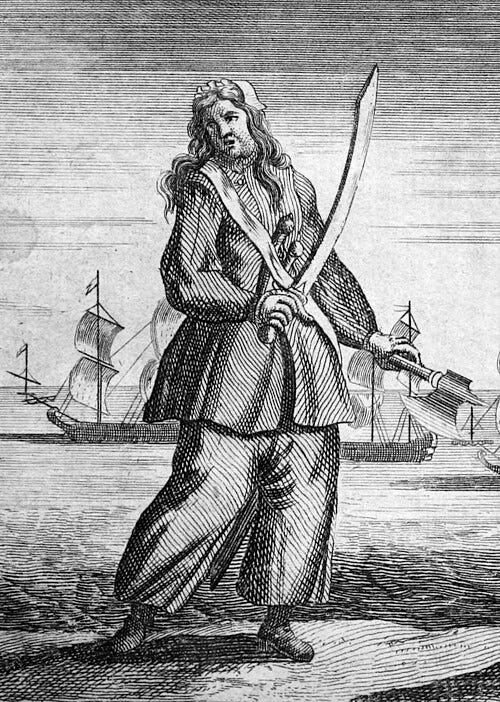
Other notable thieving legends—not named Mary—include the Irish pirate Anne Bonny, born in Ireland in 1698 and laid to rest in Jamaica in 1733 (above). She was the partner and lover of the notorious English pirate captain Calico Jack Rackham, operating in the Caribbean in the early eighteenth century. She and another pirate, Mary Read, joined Rackham’s crew and together they stole a ship — the sloop the William — in 1720.

Another famous thief from this period is Sofia Ivanovna Blyuvshtein, the stunningly beautiful woman known as “Son’ka the Golden Hand,” a Russian thief and con artist who specialized in stealing jewelry, often with the assistance of her trained pet monkey, who would swallow stones. (!!) The poor little animal.
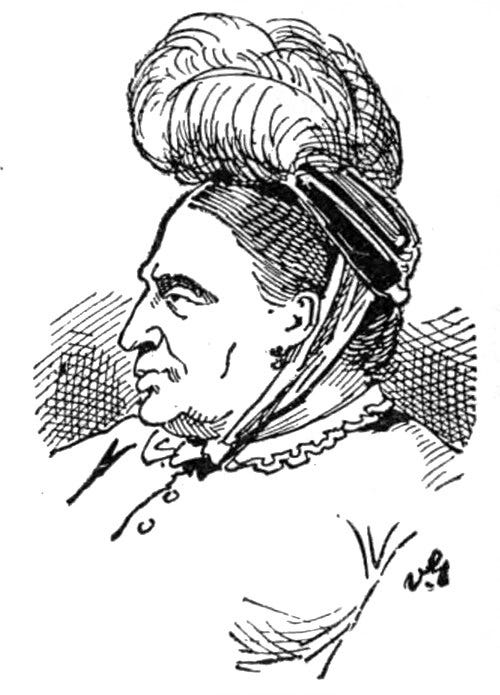
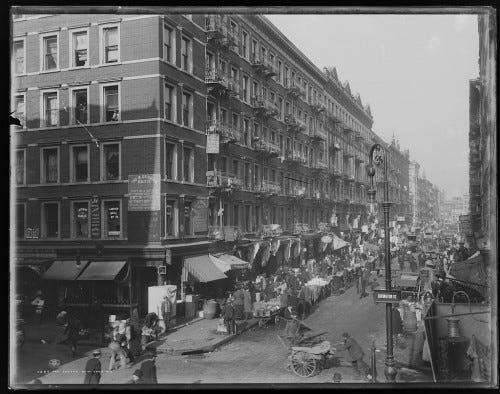
And of course there was Fredericka “Marm” “Old Mother” Mandelbaum (1825-1894), another woman given the moniker “queen of thieves,” who fenced as much as ten million dollars of stolen goods in post–Civil War New York. Her dry goods shop on Riverton Street on the Lower East Side of Manhattan (below) was a front for a warehouse likened to “Bluebeard’s Cave” with all its treasures. She was involved in organizing and financing numerous burglaries and other criminal operations including multiple bank robberies. When New York got too hot for her, she fled to Canada, and her death in 1894 made international headlines — but there was a strong suspicion that it was a heap of stones in the coffin instead of her body.
These women were clever, opportunistic, and audacious. They adopted disguises, accents, costumes, and identities with ease. It could be said their descendants are the team of women in Oceans 8.
So here’s a question: Why do we like reading about thieves — perhaps particularly women thieves? These are stories of cleverness, trickery, and transgression — which is fun to hear about, so long as we aren’t the targets. But they are also generally bloodless. I don’t mean that they’re victimless, for certainly the department stories or jewelry shops or people who were robbed were monetarily injured. However, while violence might occasionally be committed during thefts, the purpose of the crime wasn’t to kill or cause bodily injury.
The other reason? As a kid, I wanted to be able to get away with things sometimes. I also wanted to be clever enough to get away with things. (I wasn’t.) I felt sorry when I was caught, but I’m not sure I always felt sorry about what I’d done. Now, as a quasi-responsible, law-abiding adult, I do feel sorry for having someone unintentionally, but there’s a pleasure in relishing — in fiction — getting away with something successfully and being “caught” in the act only by the reader.
Who’s your favorite thief from real life, fiction, movies, or TV?