A bit of philosophical musing on the importance of view-switching
*This was originally published at Murder Is Everywhere on Substack on May 14, 2026.
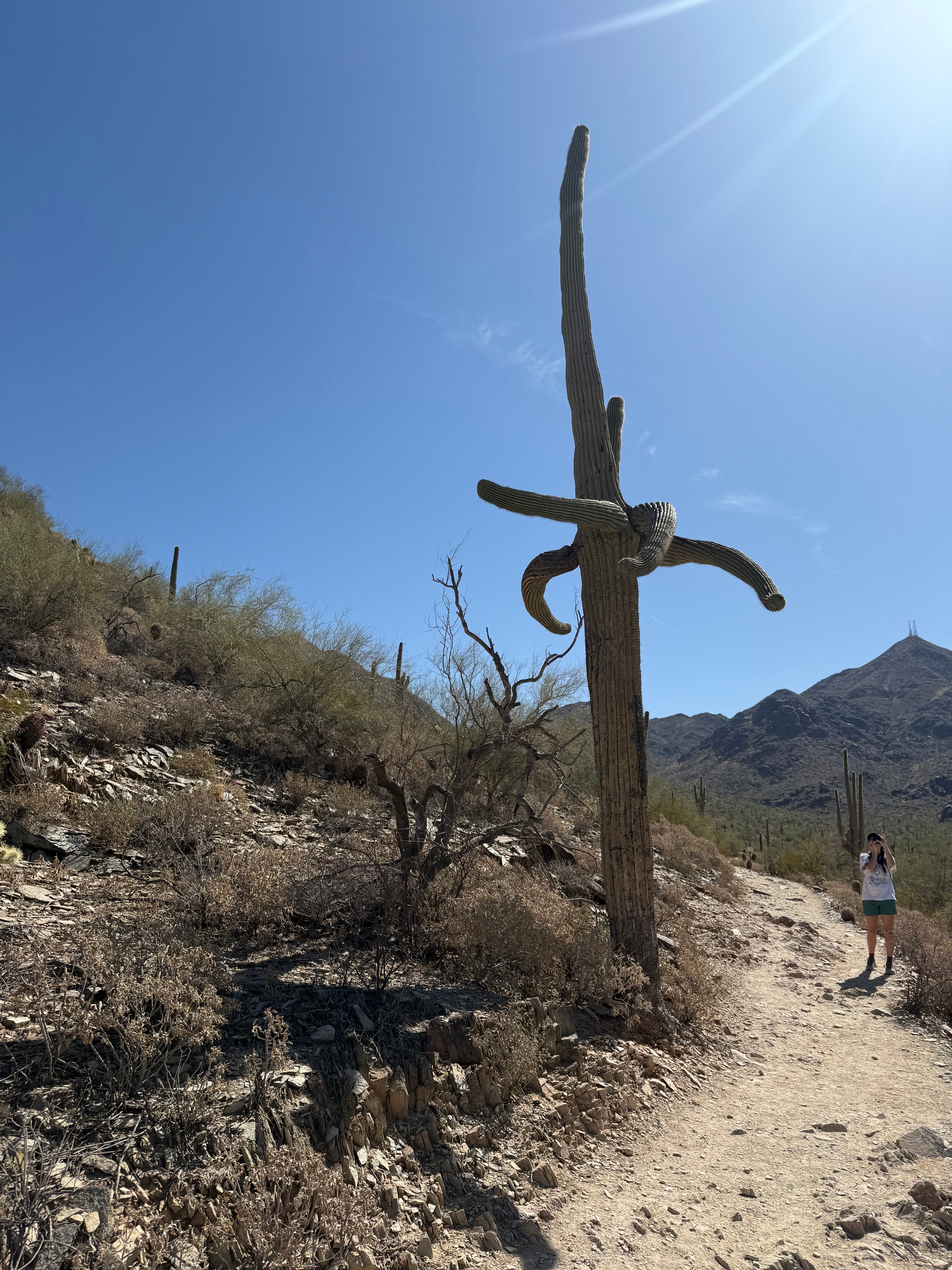
Four or five mornings a week, I hike Gateway Trail, which is a 4.5 mile loop, with 900 feet of elevation, about 15 minutes from my house in Arizona. My favorite saguaro on the trail is this one, which I called “Whirlygig,” but my friend Yi Shun Lai rechristened “Whirl-agog” because this cactus is so majestic.
These are two photos of this cactus, taken from two different spots on the trail.

Can you guess where I’m going with this?
I have come to realize the beneficial effect of pausing to look at an object or situation, metaphorically speaking, from a second viewpoint—so much so that I try to find an opportunity to do it once a day, a habit like flossing my teeth. This isn’t easy to do because usually the best moment for me to view-switch is when I’m under some sort of stress—when I’m trying to make a point in a conversation, or get something done—especially over the phone—that isn’t happening easily. But happily, when I do back out of my own head, and try to get into someone else’s, my stress level goes down. I can make allowances more easily; I can see other people’s logic; and I can more readily believe that the person on the other end of the phone is trying to help me. It makes things more pleasant all the way around.
This view-switching works in writing, too. For example, when I’m drafting a scene, sometimes it feels really flat. There’s no energy, there’s no pulse to it; it’s just getting from point A to B, conveying information. Dull as dirt. I write all my novels in first-person, so my solution to this flatness is often to back out of my protagonist’s head (“I”), and on a separate computer screen or piece of paper write the whole scene from another character’s perspective, as if s/he were the protagonist (“I”). Getting into that second character’s head shows me what s/he assumes and what s/he wants, which are different from my protagonist, creating conflict (every writer’s best friend!). Afterward, when I return to my manuscript, I often have the odd experience of feeling as if I’m watching two people on a movie screen. They’re talking and moving; I just watch and scribble it down.
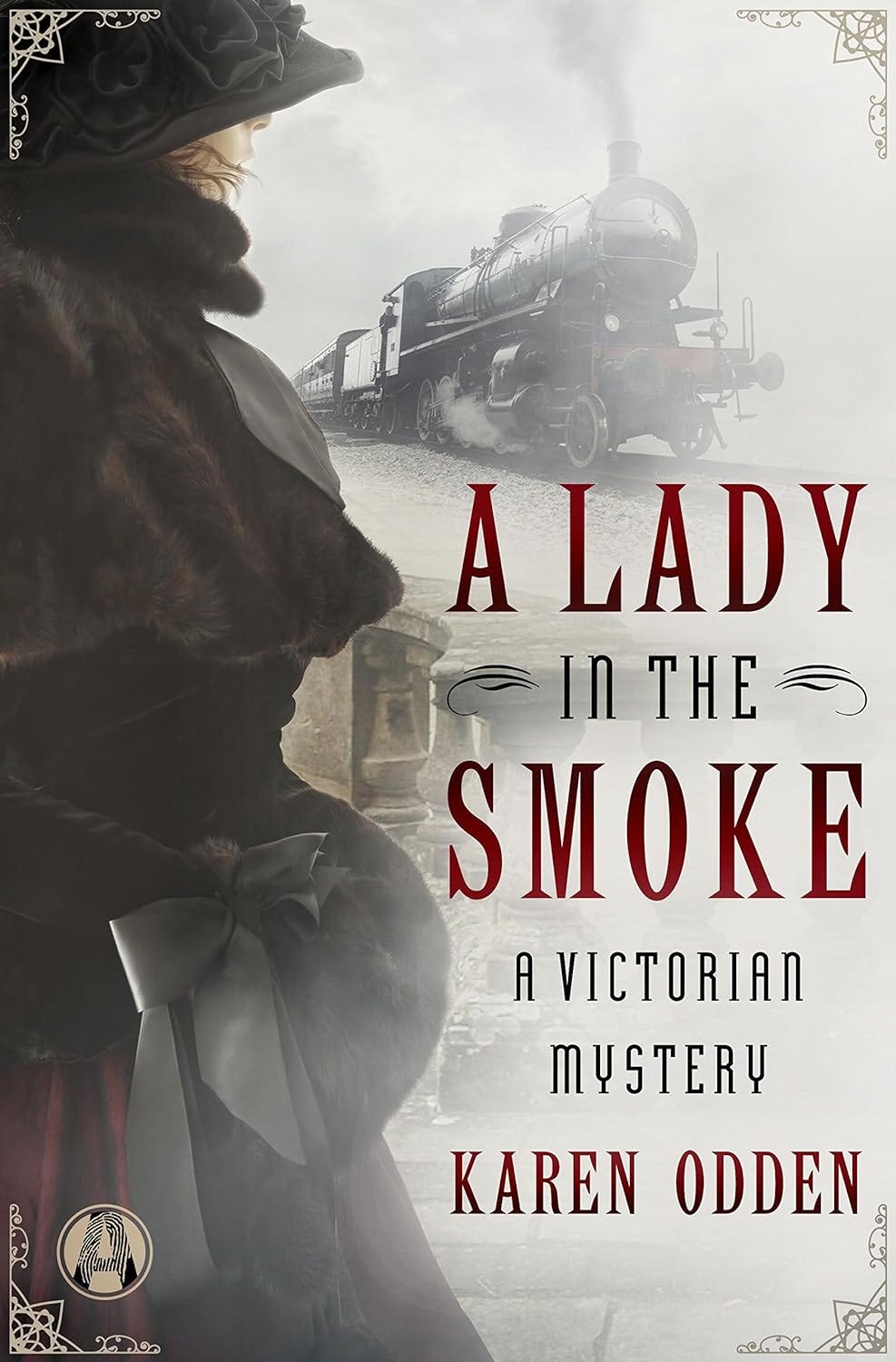
The first time I tried this, I was writing A Lady in the Smoke (2016). In this book, my heroine Lady Elizabeth Fraser, traveling with her laudanum-addicted mother, is in a railway crash in 1874. As was common practice, survivors made their way out of the train to a nearby field, where wagons and carriages from the closest town came to retrieve them, taking them to whatever accommodations could be had. Elizabeth assists Paul Wilcox, a railway surgeon, helping survivors, turning the kitchen of the boarding house into a temporary operating room.
Around chapter 8, I needed to have my heroine Elizabeth exposed as a titled Lady, not Miss Fraser. I knew my shrewd newspaperman Tom Flynn could discover her identity; so I put him in the boardinghouse parlor, waiting for her. But their exchange was dismally flat, an exchange of information, nothing more. So I backed out and got into Tom’s head.
How would he feel about Elizabeth, an aristocrat? How would he feel about her lying?
Now, Elizabeth hasn’t outright lied—she just hasn’t corrected anyone’s impression—but Tom believes she’s purposefully lied about who she is—not only to him but to his good friend Paul, who has become romantically interested in her. Righteously indignant, Tom demands to know what Elizabeth is playing at because he doesn’t want his friend hurt. Tom assumes this is just a dalliance for Elizabeth, or some sort of joke, or an attempt to escape her gilded cage for a short time—because he has assumptions about aristocratic women. At one point he says scornfully, “You are your title.”
As soon as Tom said that, I realized Elizabeth would be furious at being lumped into a group. And she has assumptions about newspapermen, too; it was a Victorian commonplace that some of them were respectable but others were salacious and only interested in selling papers. So I decided to give her a specific experience, vis-à-vis her dearest friend, Anne. A newspapermen had done a sensational exposé on Anne’s brother that resulted in him being humiliated and ostracized, which led to a serious downward spiral into alcoholism and depression. So Elizabeth spits back at Tom:
“You’re a newspaperman who probably thinks that every person with a title—all of us—is exactly the same. Men, women, young, old—it doesn’t matter. We’re all dissipated and selfish and sulking in our gilded cages. Isn’t that right?” He opened his mouth, but I pushed on, the words tumbling out of my mouth. “Or maybe you’re one of those newspapermen who thinks he’s so clever that he already knows the ending of every story—when in reality he’s so close-minded that he can’t see anything but the ugliest possible version that fits the few facts he knows! And then he throws it onto the printed page, and it sells papers because people are always eager for the most sordid gossip they can find. Never mind what it does to the people they lie about!”
A flicker of surprise, and he took a step back, as if taking my measure anew. “What has a newspaperman ever done to you?”
Tom’s initial astonishment, and his genuine curiosity about what a newspaperman had done to injure her, eventually creates a measure of trust that becomes essential to the two of them working together, with Paul Wilcox, to uncover the truth about the railway crash: it was the result of sabotage, for financial gain.
But until I got inside Tom’s head, I couldn’t find the energy in the scene. Once I’d done that, the dialog tumbled out of both their mouths; I had very little to do with it.
***
I’d love to hear some stories about people who looked at something from two sides and what happened as a result. Please share, if you have one.